
Dead Colouring: The Hidden Layer Beneath Every Old Master Portrait

There is a ghost beneath almost every portrait you have ever admired.
Before a painter of the seventeenth century committed a face to the panel, he laid down what they called the dead colouring — and it is exactly as grim and wonderful as it sounds. A flat, lifeless underlayer, grey-brown and ghostly, the whole composition blocked in without detail, light, or life, and left to dry. Only then, over that corpse-coloured foundation, did the painter build the living face: the warmth, the blush, the catchlight in the eye, the specific person. The finished portrait you admire in a gallery is standing, always, on top of a grey ghost of itself that no one will ever see again.
Why paint the dead before the living?
There were sound, practical reasons. Oil paint is built up in layers, and a monochrome underpainting let the artist resolve the hardest problems first — the composition, the fall of light and shadow, the modelling of form — before committing to colour, which is far harder to correct once laid down. The grey layer did the structural thinking. The colour, applied over it, did the seducing.
It was efficient, and it was disciplined, and it produced the luminous depth we associate with the Old Masters: those glowing flesh tones are glowing partly because of the shadowed layer beneath them, showing through. The light on the surface is borrowed from the dark underneath.
The part that fascinates me
At the dead-colouring stage, the sitter is no one yet. The face is blocked in but uncommitted — it could still become anybody. The painter has not yet decided who this person will be.
I find that unbearably evocative, and not only as a technique. Because there is a version of every one of us like that: the under-layer, the blocked-in, uncommitted self beneath the finished face we present to the world — the one that got painted over as we became someone specific, someone others could recognise and deal with. Most of the time we forget it's under there at all.
This is, I think, the single technical detail that made me want to write a painter as my narrator, rather than any other kind of person. A painter's whole craft is the management of surfaces — of how a thing is made to appear. He knows, professionally and in his hands, that the composed image on the wall is built over something hidden. It is impossible for a person like that not to understand, at some level he'd rather not examine, that he does exactly the same thing with his own face.
A question worth sitting with
So which is the real person — the finished face, composed and legible and shown to the world? Or the grey under-layer beneath it, the uncommitted self that no one sees?
I'm not sure the answer is obvious. We tend to think the surface is the performance and the hidden layer is the truth — but a painting's finished face isn't a lie about the grey beneath it. It's what the grey was for. Perhaps people are the same: not a true self hidden under a false one, but a surface that the depths were always working toward. Or perhaps not. My narrator spends a whole book not looking too closely at his own underpainting. I understand the impulse.
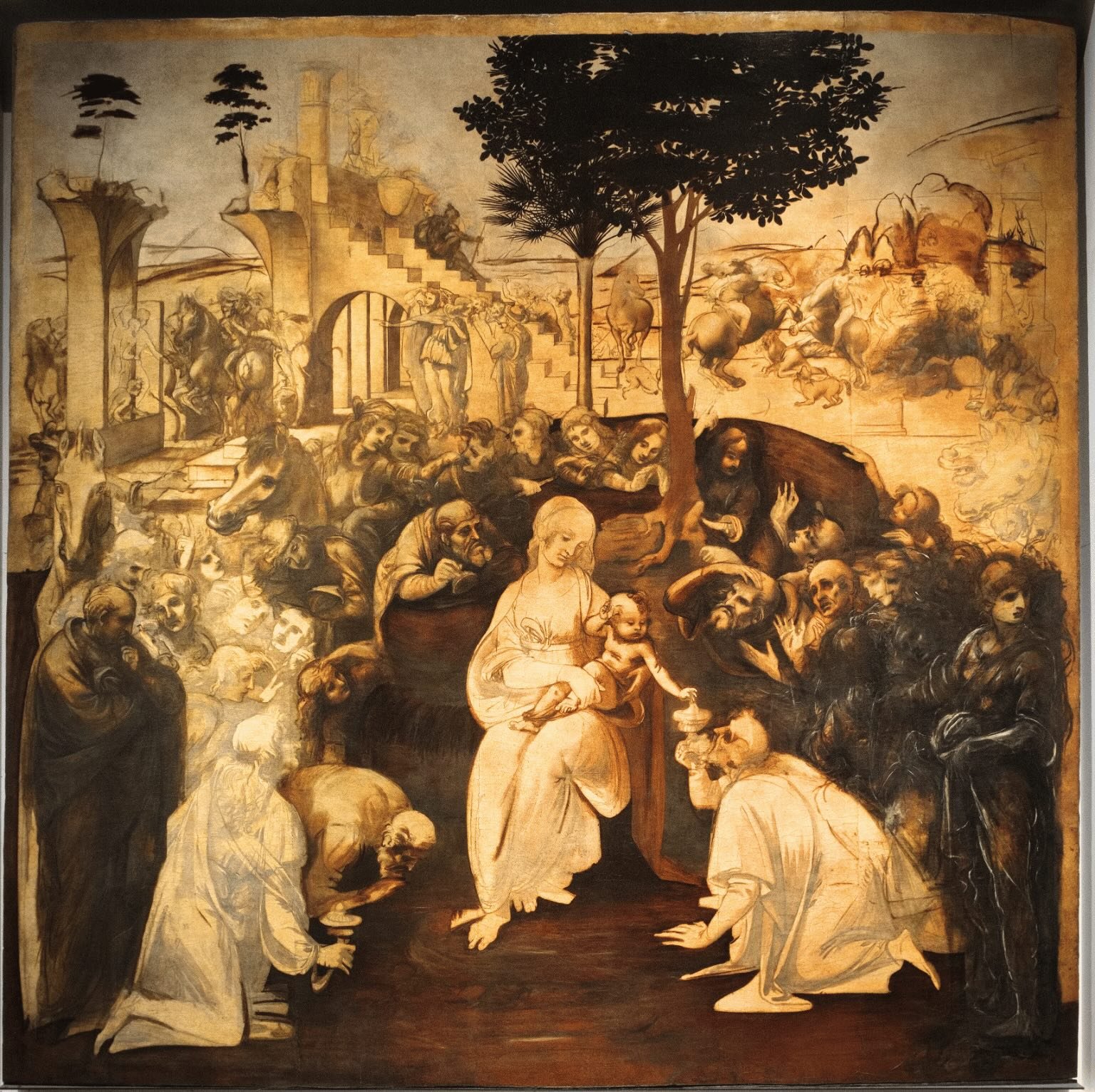
Leonardo da Vinci, Adoration of the Magi, c. 1481, for San Donato in Scopeto, unfinished, 244 x 240 cm., Uffizi, Florence. Image: Armin Kleiner, Creative CommonsAttribution-Share Alike 4.0 International
