
FREE ASSESSMENT
The Period
Eye
A complimentary historical assessment of up to 2,000 words, focused on the category that matters most to your manuscript.
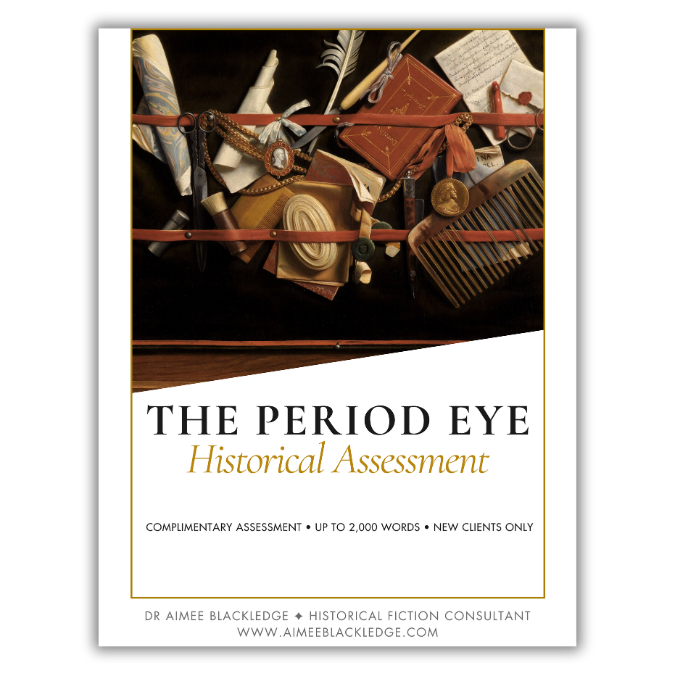
The Period Eye is a complimentary historical assessment I occasionally offer to writers who are considering working with me. Submit a scene, a chapter opening, or any passage from your manuscript of up to 2,000 words and choose one of four categories for me to assess. I'll return a thorough written audit in the same format I use for paid clients.
This is a genuine sample of what I do.
New clients only
Subject to availability
Early Modern Europe · 1500–1800
CHOOSE YOUR CATEGORY
One area of focused assessment, using the same eye I bring to every manuscript I read.
When you submit your passage, you’ll select one of the four categories below, and I’ll assess it with the full rigour of an Oxford-trained art historian and historical fiction author.
01
Language & Dialogue
Anachronistic words and phrases are identified, with period-appropriate alternatives and etymologies provided. Your period has its own rich vocabulary; the aim is to help you find it.
02
The Material World
Every described object will be assessed for period, location, and description accuracy, including: furniture, lighting, vessels, tools, coinage, writing materials, and more.
03
Fashion & Dress
Garments, fabrics, fastenings, layering, and the social meaning of dress will be assessed against the period, location, and your character's station in life.
04
Social Hierarchy & Class
Forms of address, deference, the choreography of social space, and the unspoken rules that govern the public sphere, your characters move through.
‘Getting the history right is not about filling your manuscript with facts. It’s about making your world feel so real and inhabited that the reader never has cause to question it.’
— Dr Aimee Blackledge, DPhil (Oxford) · Historical Fiction Consultant & Art Historian
HOW IT WORKS
01
Submit your passage
Fill in the form below with your manuscript details and submit up to 2,000 words of your choosing — a scene, an opening, a passage you're uncertain about.
02
I read and assess
I apply my full attention to the category you selected — going deep on your passage rather than wide across all categories. I'll confirm availability within one business day of receiving your submission.
03
You receive your report
A written Period Eye assessment delivered as a formatted document, usually within two weeks. No Zoom call — just the work, delivered to your inbox.
WHO THE PERIOD EYE ASSESSMENT IS FOR
Writers who know that getting the history right matters
✦ You are writing historical fiction set in Early Modern Europe (1500–1800)
✦ You have a passage ready to submit, a scene, an interior, a moment of dialogue or social interaction, any extract up to 2,000 words that gives me something to work with in your chosen category
✦ You are a new client who has not previously worked with me
✦ You are genuinely considering commissioning a paid service and want to see my work before you commit
✦ You understand this offer is subject to my current availability and is not guaranteed
SEE IT BEFORE YOU SUBMIT
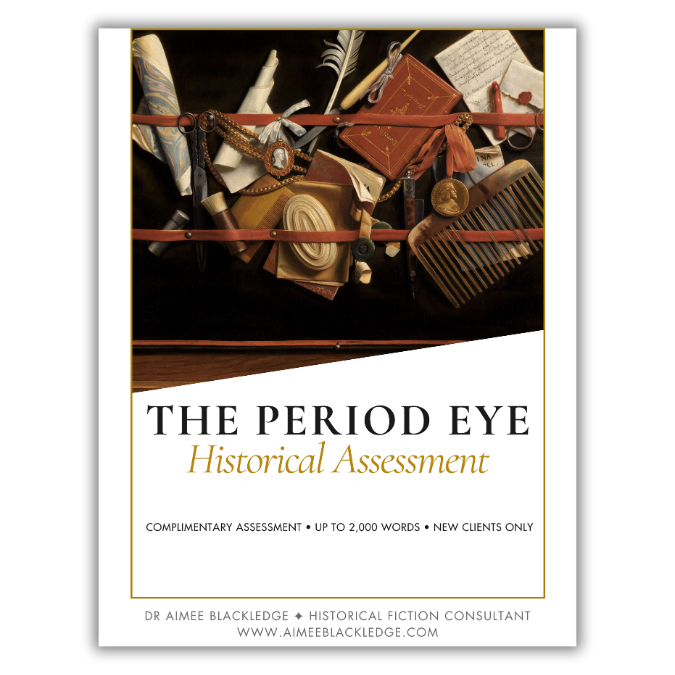
Sample Period Eye Assessment
Before you submit, you're welcome to read a complete sample assessment focused on The Material World & Objects based on a fictional manuscript extract set in Venice, 1553. It is assessed entirely within that one category. This is exactly what your assessment will look like: the same format, the same depth, the same annotation style used for paid clients.
REQUEST YOUR PERIOD EYE ASSESSMENT
Start the process
Fill in the details below, and I'll be in touch within one business day. I'll confirm whether I'm able to take on your assessment in the current period and send you instructions for securely submitting your 2,000 words.
Please note: The Period Eye is for new clients only and is subject to my current availability. Extracts must be from a historical fiction manuscript set in Early Modern Europe (1500-1800).
Submitting this form does not guarantee an assessment. Occasionally, I’m unable to take requests in busy periods. If this is the case, I’ll be in contact within one business day to let you know when you can expect me to reopen submissions.