
Frost Fairs: When Londoners Threw a Party on the Frozen Thames
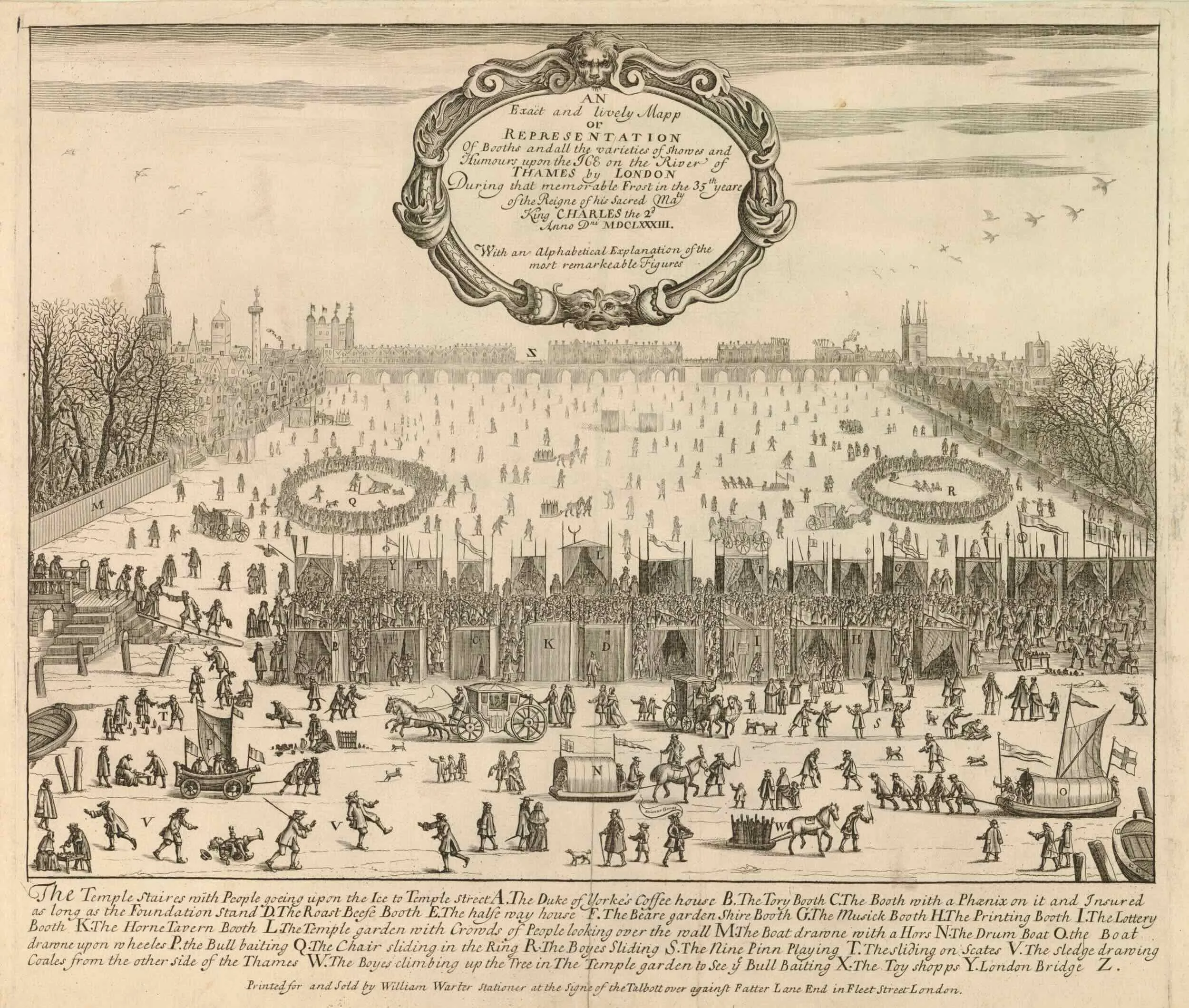
Unknown artist, An Exact and Lively Mapp or Representation of Booths and all the varieties of showes and humours upon the Ice on the River of Thames by London, 1684. Etching, 1862,0712.655. © The Trustees of the British Museum. Shared under a Creative Commons Attribution-NonCommercial-ShareAlike 4.0 International (CC BY-NC-SA 4.0) licence.
In the seventeenth century, bitterly cold winters froze the River Thames solid enough to hold crowds of Londoners. This happened mostly on the stretch of the river west of the Old London Bridge, where ice blocked timber casings acted like a dam for the estuary tide. When it did, Londoners turned the events into recreational festivals known as frost fairs.
The icy surface provided enough room for Londoners to erect streets full of stalls. Vendors sold roasted meat and hot spiced ale. Barbers, pubs, fruit sellers and shoemakers set up makeshift tents selling their wares and services. Even printers hauled their presses onto the ice to sell souvenirs with your name and the date. Londoners came for ice-skating and sledging, bull-baiting, dancing, and (on at least one famous occasion) an ox roasted whole over a fire built directly on the frozen river.
People walked, drank, gambled, and flirted on a surface that was simply a sliver spanning over deep, fast-moving black water. The buzzing fair sat on top of a river that could open beneath it without warning, and did, on occasion, with fatal results. But Londoners chose not to think too hard about what was underneath, and chose to revel nevertheless. This was where Londoners went to enjoy themselves, and somewhere in the crowd, someone fell in love for the first time, lost a fortune, discovered an unknown talent, or even perhaps planned an escape to a new life. There is something so human about a crowd dancing on a precarious surface, refusing, for one afternoon, to look at the risks.
Having grown up in the deep, cold winters of Michigan, I have always been wary of trusting the ice, which is why Frost Fairs that mix pleasure with a little danger are so intriguing to write about. Clouded in Clerkenwell is set in a hard winter, which is, strictly speaking, not a frost-fair year. But the ice is strong enough for an impromptu fair on a much smaller scale, with less safe conditions.
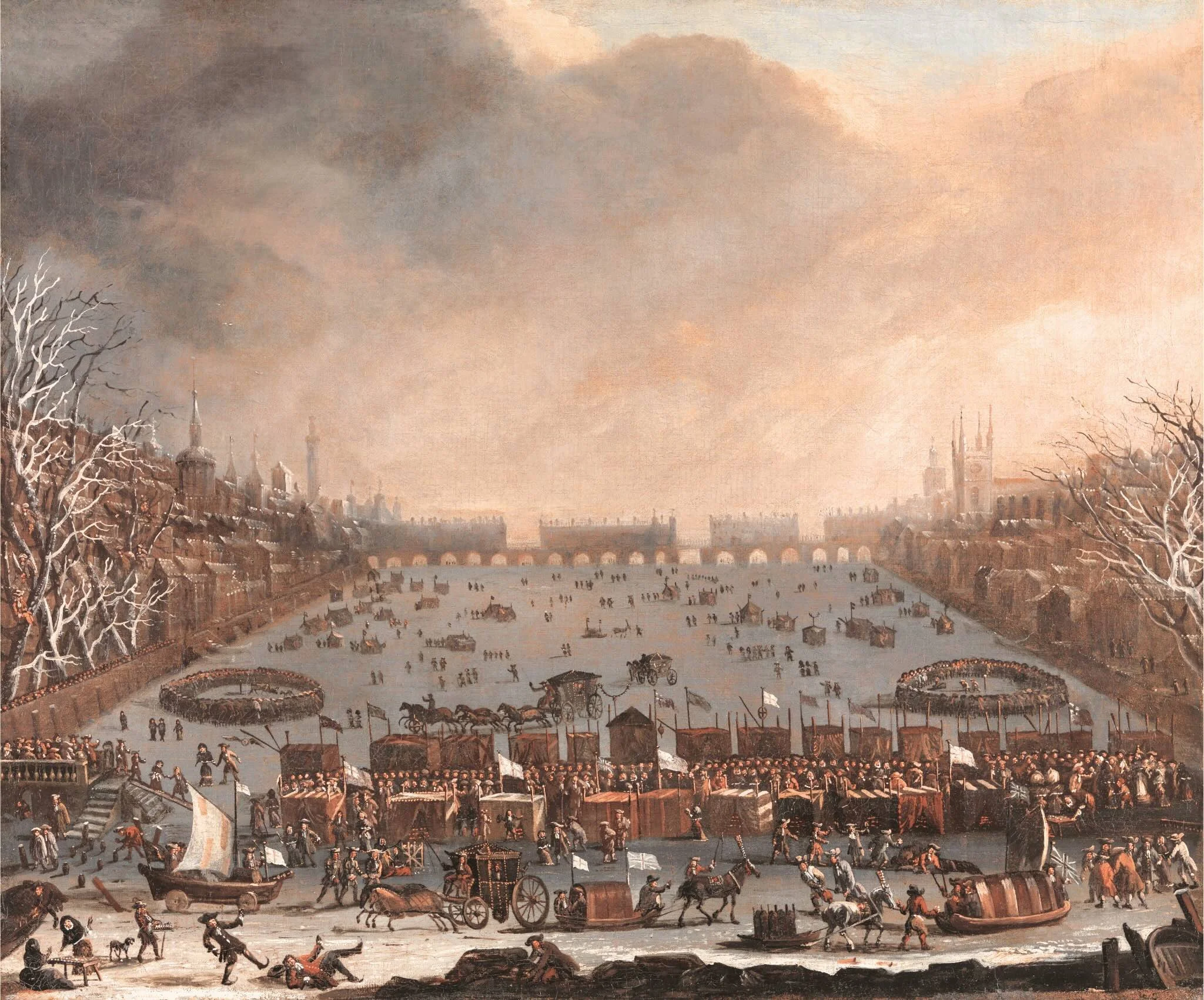
Unknown artist, Frost Fair on the Thames, with Old London Bridge in the distance, 1684, Oil on canvas, Yale Center for British Art, Paul Mellon Collection, B1976.7.113.
