
The Beautiful Poisons on a Seventeenth-Century Painter's Palette
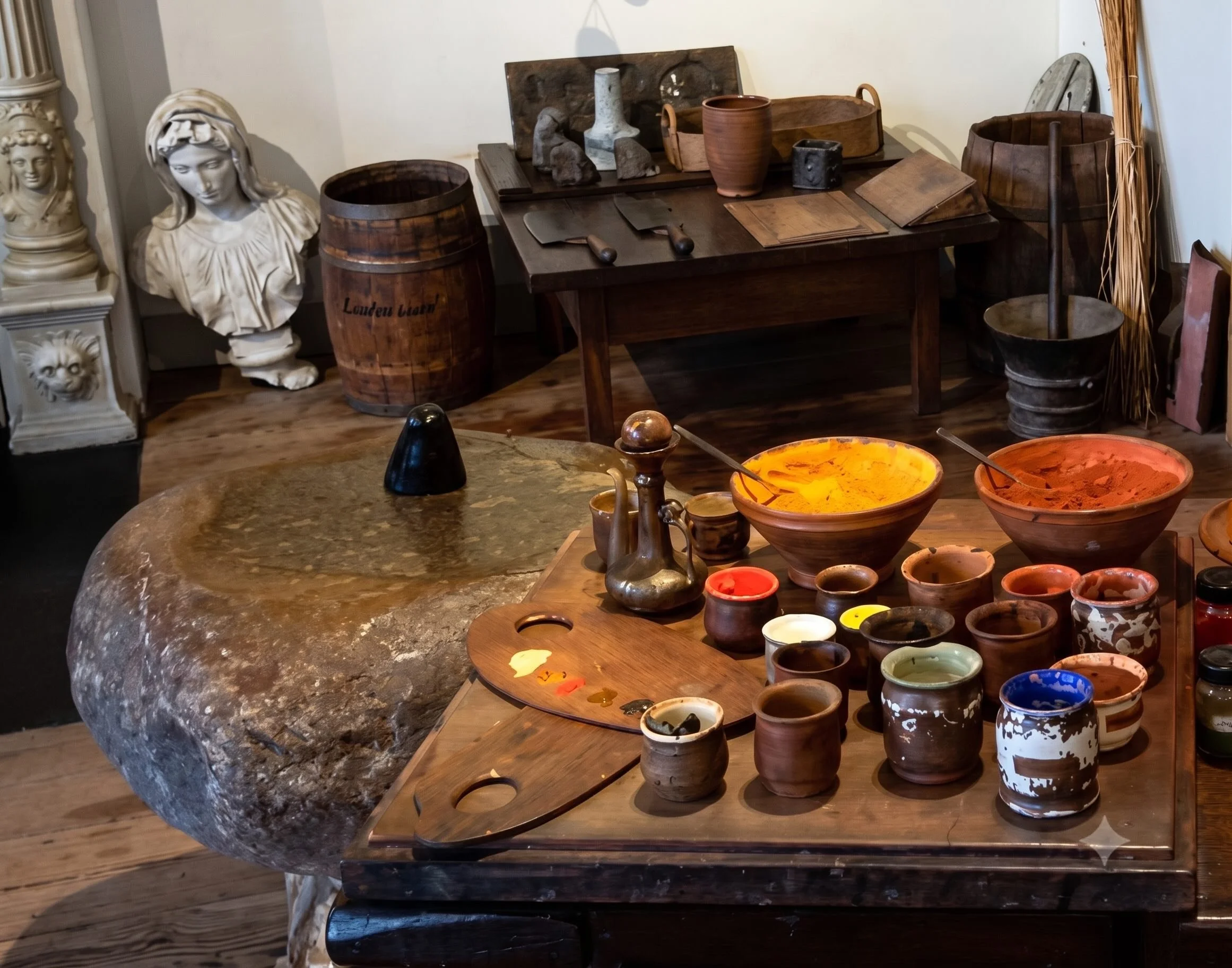
The Rembrandt House Museum, Colourtable, 2013. KotomiCreations, Flickr, Creation CC-Attribution-noncommercial 2.0 generic.
A seventeenth-century painter's shelf was, among other things, a small cabinet of poisons.
Consider what my Henry handles before breakfast. Lead white — the essential, luminous white of every flesh tone — heavy and chalky and faintly sweet, sweet enough to turn the stomach if worked too long, and slowly, cumulatively toxic to the men who ground it with bare hands, day after day. Orpiment, the glorious golden yellow that nothing else could match, was arsenic. Vermilion, the arterial red of a cardinal's robe and a wealthy woman's lips, was ground from cinnabar — mercury ore — and stained the knuckles for weeks. Verdigris, the fierce green, was corroded copper.
Painters knew, more or less, that some of this was bad for them. And they went on grinding it anyway, with their hands, because nothing else made that white, that yellow, that red — and a painting had to be beautiful, and beauty was made of poison, and that was simply the cost of the trade.
I find that almost unbearably apt, because it is the entire moral shape of my novel compressed into a paint box. My characters are reaching, always, for something beautiful and expensive — success, recognition, a studio of their own, a life that matters. And the reaching is quietly costing them something they'd rather not look at too closely. They know. They grind it anyway.
The question this raises
Here is what the painters understood in their hands, if not in words: that the thing you want most can be poisoning you at the very moment you're making something beautiful with it, and that knowing this changes almost nothing. You still need the white. You still want the gold. So — does clear knowledge of a cost ever actually stop us reaching for the thing? Or do we just get better at not working it too long, and try not to notice our hands stiffening? I wrote a whole book to sit inside that question. I still don't have the answer.
The part that fascinates me
The pigments in the novel are all real, drawn from genuine period sources — I leaned on the technical scholarship on seventeenth-century palettes rather than reaching for the colours a modern reader might expect. (There is a particular satisfaction, and I won't pretend otherwise, in resisting the urge to fill a historical studio with vivid modern hues that wouldn't have existed for another two hundred years.)
But the reason the pigments matter isn't accuracy for its own sake. It's that I wanted the materials of Henry's world to carry the book's meaning — a trade where beauty and poison come from the same jar, handled by the same bare hands. Sometimes the research doesn't just decorate the theme. It is the theme, sitting there on the shelf, waiting to be ground.
