
Seven Years to a Trade: What It Meant to Be a Painter's Apprentice in 1641
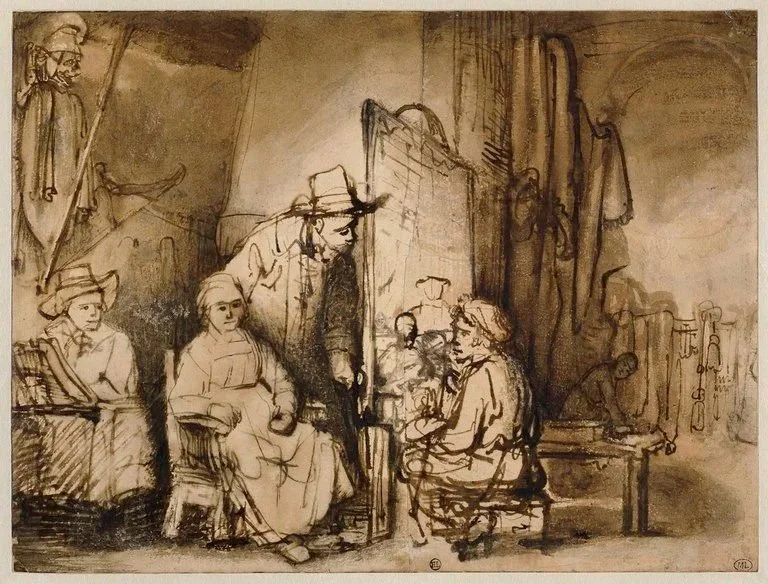
Rembrandt van Rijn, A painter in his studio painting the portrait of a couple, c. 1645-50, Pen and brown ink, brown wash, 17.5 x 23 cm., Louvre, RF 690, Front
If you wanted to become a painter in seventeenth-century London, you did not go to a school. You were bound — by a legal indenture, usually for seven years, to a master in whose house you would live, sleep, and labour from before first light. Your parents paid for the privilege. And in return, you swept the floor.
For the first years, an apprentice was closer to an unpaid servant than a student. He ground the pigments, scrubbed the brushes, ran the errands, prepared the panels, cooked, and cleaned. If he was lucky and gifted, and the master was decent, he was slowly, grudgingly taught the actual craft — how to lay a ground, mix a flesh tone, render a hand. If he was unlucky, he spent seven years as cheap labour and emerged having learned very little except resentment.
The grinding alone was a world. A good apprentice came to know each pigment by its resistance under the muller — the way smalt pushed back with a gritty stubbornness, how some lakes surrendered almost at once into something close to silk, how lead white was heavy and chalky and faintly, nauseatingly sweet. Your hands stiffened by evening. Some of what you ground was quietly poisoning you. And all of it was in the service of a painting that would carry someone else's name.
My Henry is five years into exactly this. Two more to go. He is, by his own rueful account, luckier than most — he's actually being taught, because he does most of the real work — but "luckier than most" is a thin thing to warm your hands on when the family you're providing for is a hundred and seventy miles away, and your master takes the credit for your best work.
The question this raises
There is a particular patience the whole system demanded: serve now, and someday it will be yours. Seven years of someone else's ambition, on the promise of your own at the end of it. But a promise that far off is easy to keep dangling and hard to ever quite collect — and I found myself wondering, writing Henry, at what point loyal patience curdles into something more like a cage. When does "nearly there" stop being a comfort and start being the thing that keeps you in your place?
The part that fascinates me
I wanted to get the texture of the labour right, because it's where Henry's whole character lives. He is a young man who is extraordinarily good with his hands and has been made to use them, for five years, mostly for menial work — and that gap, between what he can do and what he's allowed to do, is the pressure the whole book runs on. So I spent an embarrassing amount of time on the specifics of grinding pigment: the porphyry stone, the weight of the muller, the way each colour feels different under it. It's the kind of detail that could sink a novel if you show off with it — but held lightly, it's the difference between a costume and a life.
