
Van Dyck's Death and the Vacancy That Started a Novel
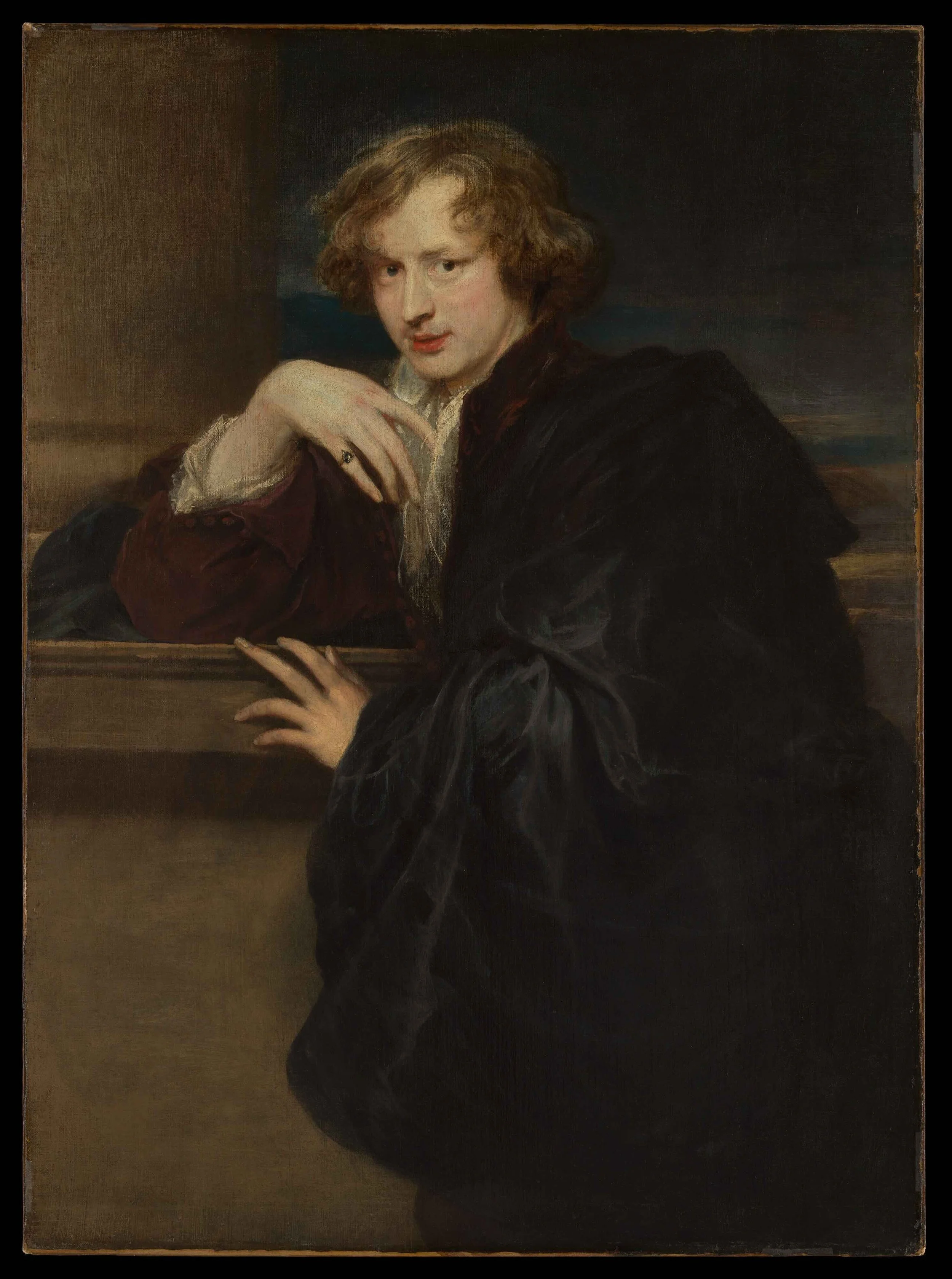
Anthony van Dyck, Self-Portrait, c. 1620–21. The Metropolitan Museum of Art, 49.7.25.
On the 9th of December 1641, the Flemish painter Sir Anthony van Dyck died at his house in Blackfriars at the age of forty-two, and the most coveted position in English painting fell suddenly, gloriously empty.
As "Principalle Paynter in Ordinary to their Majesties," Van Dyck had reinvented how the court of Charles I wished to see itself. The king loved him enough to build a private causeway to his studio door from the Thames, and paid for a lavish funeral and a monument in St Paul's Cathedral. No English painter could touch him, and every English painter knew it. So his death did something more complicated than generate grief. It opened a space.
And not everyone was sorry. For every painter who mourned the Flemish master's passing, there was another quietly calculating what his absence might be worth: a commission that might now come their way, a rival suddenly gone, a ceiling lifted. It is one of the least romantic and most human truths of any profession, that another's ruin is so often your opportunity, and that the two can be impossible to tell apart from the inside.
That vacancy, and the scramble of lesser, hungrier, more desperate men to fill it, is where my novel Clouded in Clerkenwell begins.
The part that fascinates me
Here is a detail I had to resist putting all of it into the book. Van Dyck's reputation didn't stay still after he died; it kept being rebuilt by people who needed it. A century later, English portrait painters, still struggling to be taken seriously, reached back through history and made him their founding saint: they constructed the story that his gatherings had been a kind of ‘Virtuosi Club of St Luke,’ and they even emulated the idea to start social gatherings among the painters living in London. Some, like the miniaturist Richard Cosway, modelled their very self-image on the Flemish master. A dead man, still being used by the living painters to get what they wanted — a century after he vanished from the professional stage.
I find that irresistible, because it's the same instinct my characters have. They just do it within days rather than centuries, and with far less dignity.
A question worth sitting with
The men who moved to fill Van Dyck's place were not selfish. They were driven and hungry. As a door had opened, they decided to walk through it, telling themselves, no doubt, that they were simply being sensible. Which is the question my novel keeps circling: when we tell ourselves we had no choice, is that the truth, or a ploy to absolve ourselves of the guilt? You can step into the space a dead man leaves. But does the space ever quite stop being his?
If you want to read how my painter’s story begins on the day of Van Dyck’s death, you can read the first chapter of Clouded in Clerkenwell for free by clicking below.
