
The River That London Buried: The Fleet in 1641
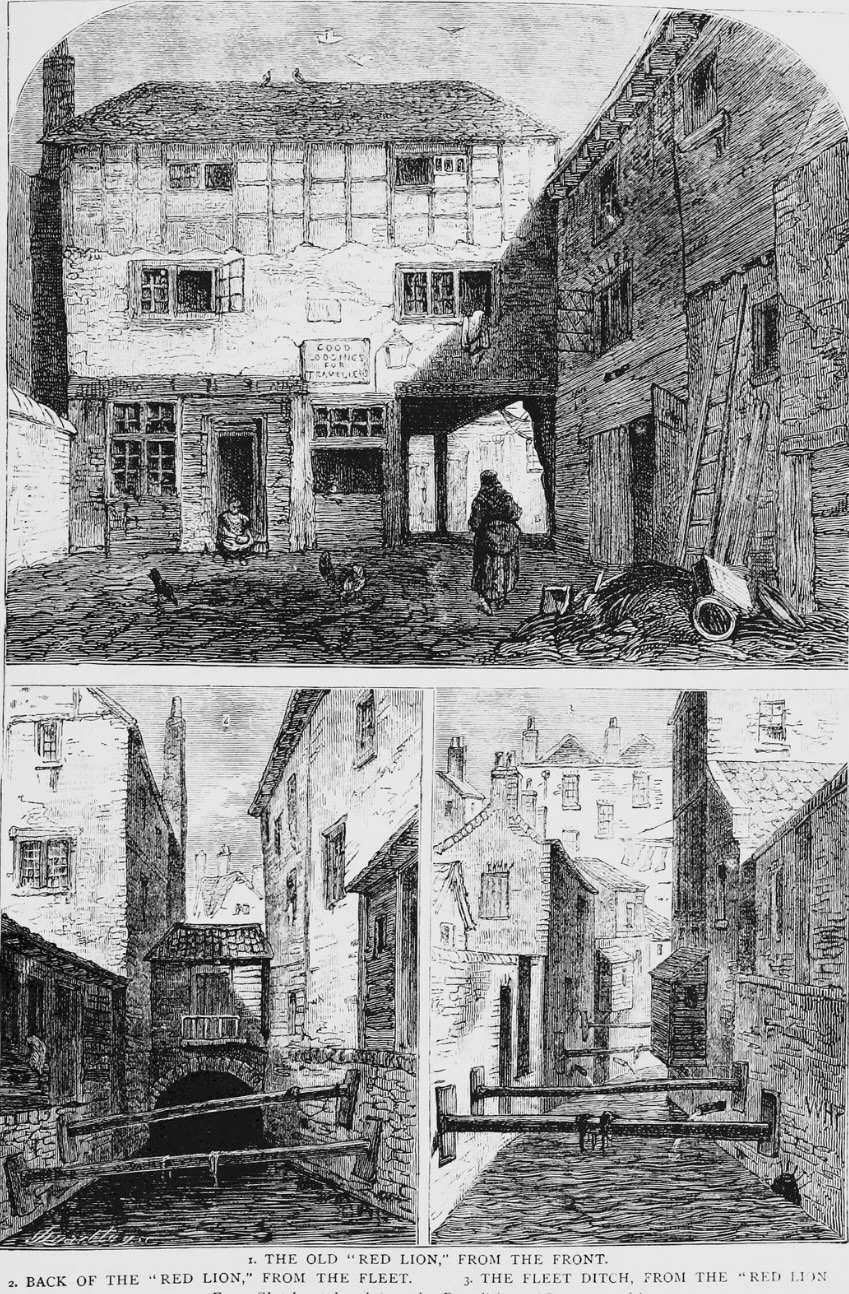
William H. Prior, The Fleet, from the Red Lion, 1844. Engraving, in Walter Thornbury, Old and New London: Volume 2, 1878.
My novel Clouded in Clerkenwell opens on a young man standing at the edge of the River Fleet, in the dark, in a hard frost, looking for the deepest part of the current — because he has something he badly needs the river to take.
He chose the right river.
By 1641, the Fleet was barely a river at all. Once a real waterway running down to the Thames, it had spent centuries being used as London's drain, and by the seventeenth century it was a thick, reeking channel of everything the city wanted gone: the waste of the tanneries, the offal of the Smithfield shambles, the emptyings of ten thousand households. Contemporaries complained of the stench; people crossing near it learned to breathe through their mouths. It was less a river than an open wound the city had stopped looking at.
And that is precisely what made it useful. The Fleet was where a neighbourhood sent what it could not keep and did not want found — where you went, quietly, at night, to be rid of a thing. A river like that keeps your secrets, or seems to. It is filthy, and fast, and nobody with a choice goes looking in it.
Where the river went
Here is the part I find almost unbearably apt. The Fleet, over the following centuries, vanished. It was covered over, built upon, culverted, and paved — until today it runs entirely underground, beneath the streets of London, a buried river that the city walks over without a thought. It's still down there. It never left. It was simply covered so thoroughly that everyone agreed to forget it.
You can still find it, if you know where to listen. In a few places, through a grating in the road, you can hear water moving under the pavement — the ghost of a river, still running its old course beneath the traffic.
A river that spent centuries carrying away what London wanted hidden, and was then itself hidden. The past covered over and paved flat, still running underneath. As a metaphor for a novel about the things people bury and hope stay buried, I could not have invented anything better — so I didn't. I just opened the book there.
A question worth sitting with
The Fleet promised what all such places promise: throw it in the deepest channel, and it's gone. But a buried river isn't gone. It's out of sight, still running, still there under everything, audible through a grating if you stop to listen. Which is the question the whole novel turns on: is getting away with something the same as being free of it? You can dispose of a thing. But disposing of it and being rid of it, my narrator is about to learn, are not at all the same.
If you want to read how the River Fleet features in my novel, you can read the first chapter of Clouded in Clerkenwell for free by clicking below.
