
Blood and Playhouses: London's Disreputable Entertainments in 1641
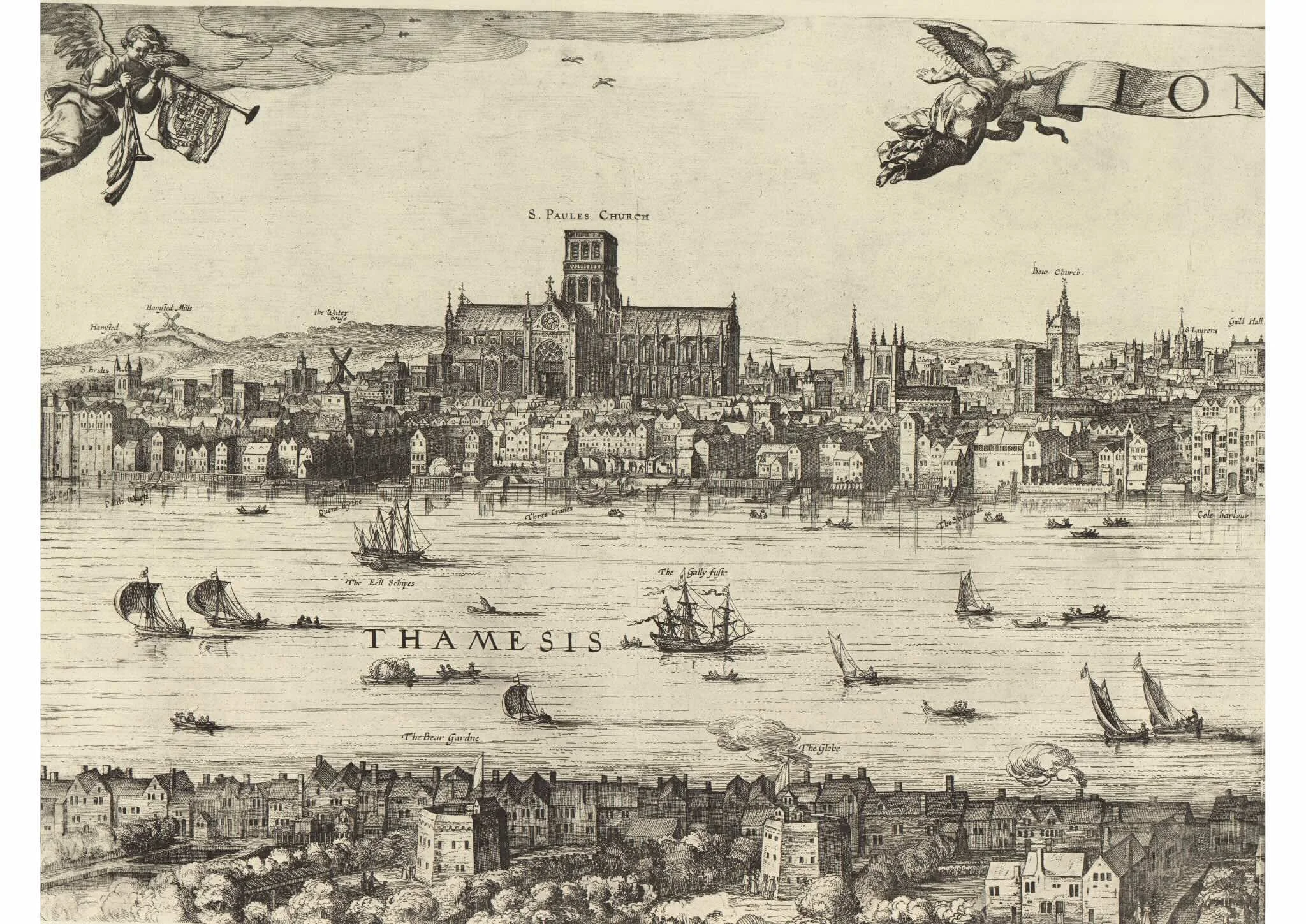
Claes Jansz. Visscher, View of London, 1616. 1 view on 4 sheets, sheet 4, 59 x 80 cm., in the digital collection UM Clark Library Maps. https://quod.lib.umich.edu/c/clark1ic/x-003020531/39015091198336_04. University of Michigan Library Digital Collections. Accessed August 16, 2026.
If you wanted to lose an afternoon and possibly a wager in the London of 1641, you crossed the river to Bankside.
The south bank of the Thames, in Southwark, was the city's disreputable playground, deliberately outside the jurisdiction of the po-faced authorities who ran the City of London proper. And so it filled up with everything they frowned on: the playhouses, the taverns, the brothels (politely called ‘stews’), and bear gardens.
The bear gardens are the ones that stop a modern reader cold. They were exactly what they sound like, great open rings where a chained bear was set upon by mastiffs, for the roaring entertainment of a paying crowd that included, on perhaps even the King himself. The most famous bears were celebrities of a sort, with names the crowd knew: Harry Hunks, Ned Whiting, and Blind Bess. They drew huge crowds, commanded high gambling stakes, and gained legendary reputations for fighting off dogs. It is genuinely grim and genuinely beloved, and both tell you something about the period.
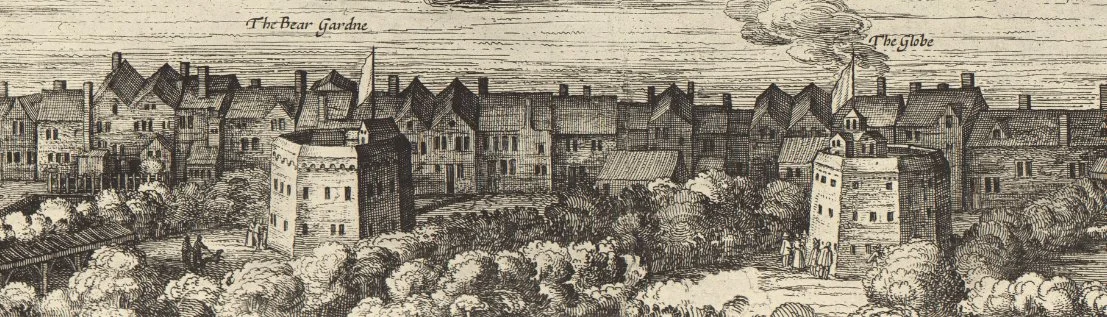
Detail: Men walking a dog near the Bear Garden across from The Globe Theatre.
High art and blood sport
What I find fascinating is that the same corner of London held the bear gardens and the great theatres. The Globe, the Rose, and the Hope. The Hope doubled as a bear-baiting ring on the days it wasn't staging plays. High art and blood sport, Shakespeare and Sackerson, sharing the same space and often the same building. The Hope was a polygonal wooden building with tiered galleries. Its movable stage allowed for bull- and bear-baiting as well as plays. By the 1620s, bear-baiting was the dominant entertainment here, as leading acting companies largely avoided the theatre. Other entertainment included prize fights, fencing matches, and exhibitions of wild animals.
Nor was Bankside the only home of the drama. North of the river, the playhouses my own painters might plausibly have known were still standing in 1641: The Fortune in Clerkenwell's neighbour Cripplegate, and The Red Bull in Clerkenwell itself, both raucous, popular, working-class houses a world away from the courtly refinement Van Dyck painted. The Red Bull in particular had a reputation for loud, boisterous audiences and broad, crowd-pleasing fare. Exactly the kind of place a struggling painter might go to forget his debts for an afternoon.
It would not last. In September 1642, as the country tipped into civil war, Parliament ordered the theatres closed. The playhouses that had roared for half a century fell silent, and many never reopened. My novel is set in the final months before that silence — the last winter of the old, loud, disreputable London.
However, the story was different for bear gardens. The Bear Garden at the Hope mostly remained active during the English Civil War, despite a brief parliamentary closure order in November 1643. It reopened by 1645 and continued hosting blood sports until February 1655, when Colonel Thomas Pride ordered the building to be torn down and the bears shot in 1656. Another Bear Garden was rebuilt a short distance to the south during the Restoration.
A Clerkenwell footnote
While Clerkenwell had its own notorious bear-and-bull-baiting ground, Hockley-in-the-Hole, its real heyday came a little after my novel: it roared loudest in the decades around 1700, a byword for low sport and lower company. My painters, in 1641, were a generation too early for it.
I mention it anyway, because it belongs to the character of the place I write about and was located in the valley of the River Fleet. Clerkenwell was, and would remain, a district on the edge, just outside the rules, hospitable to the things the respectable city preferred to keep at arm's length. Hockley-in-the-Hole is what that edge would become. It's the same appetite, a few decades on.
The part that fascinates me
I keep a private rule when I'm building this world: never sand off the parts that make a modern reader wince. It would be easy to write a tasteful seventeenth century, all candlelight and lovely fabrics, but it would be a lie, and, worse, it would be boring. The bear gardens stay in the mental map of my London precisely because they're uncomfortable.
My characters live in a world that is beautiful and cruel in the same breath; a city that would stage a tragedy and a bear-baiting in the same building, and see no contradiction. If I flinched from the cruelty, the beauty wouldn't mean anything.
Learn more
If you are interested in learning more about the role of animal baiting in the early modern period, visit the UK Arts and Humanities Research Council-funded project Box Office Bears, which brings together researchers from the Universities of Nottingham, Roehampton and Oxford and project partner Museum of London Archaeology (MOLA): https://boxofficebears.com/
